
Hi Friends,
Happy Monday!
Aftermath, by James Rickard
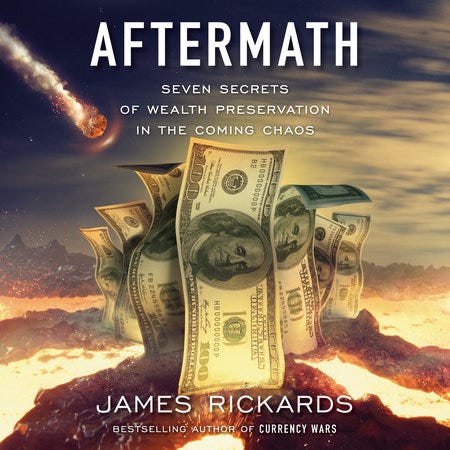
I recently finished this book, by James Rickards.
It is a very controversial book.
I’ll start with the bad:
He is quite emotional in his writing. Not the good kind of emotional that makes you feel stuff. The kind where you want to put the book down, pick up the phone, and tell the author to just stick to the facts.
His storytelling isn’t great. At the chapter level, it is alright, but at the book level, you don’t finish it and think wow, that was a great story. I had that feeling with The Art of Learning for example. Not there. All the more frustrating that he repeats that it is his 4th book in this series - the only one I tried because it had the highest reviews on Goodreads plus I assumed his thesis would have gained in maturity.
His logical chain of thought is not always 100% iron-clad. It made me think - not for the best - of translating some of Plato’s rhetoric back in high school. “You know how baby horses can stand up from birth? In the same way, humans need to adapt fast to their environment. It means you should buy gold.”
Long story short, it does not always make perfect sense to me why his conclusion is always to include gold in your personal portfolio’s asset allocation. I do agree with the idea, but either he should have made each chapter a full book with much more detailed explanations and logical steps, or he should have tweaked his story a bit.In a book like this one, I would have expected a chapter on cryptocurrencies / decentralised ledgers.
The good side of the story:
With a bit of critical thinking and side research, I fundamentally agree with most of the points he makes.
Some parts of his story are often personal conversations with very senior public figures, which would be very hard to come by via any other source.
He did his thorough research on monetary mass gold-backing. Some of the ratios he uses are rather unique. I had initially seen the book quoted for those a financial report, and I could not find corroborative data anywhere. This is why I decided to get the book in the first place.
His most interesting points:
Great experience and thinking around trade balances and geopolitics - it really gives a solid overview and introduces the right concepts.
Very solid thesis on monetary supply and gold as a reserve value. I would have loved more/older historical lessons, but still well-researched and instructive. This is the book’s core idea.
Some decent facts and ratios about debt, but I would much rather refer to Ray Dalio’s Principles for Navigating Big Debt Crises or Changing World Order: Why Nations Succeed Or Fail.
Interesting second-order thinking about passive investments and the ETF wave. I already shared his concerns, but the significant positive societal impact can’t be ignored either.
Extremely original thoughts on behavioural economics applied to “improve” society - a very interesting take both from a moral and practical perspective.
In conclusion, neither the book I would bring on my desert island nor one I would re-read from cover to cover, but definitely not regretting the read either.
Read my full reading notes here: Aftermath - Seven Secrets of Wealth Preservation in the Coming Chaos
Thanks for reading and have a great week, full of mind-changing readings,
V