
Hello Friends,
And happy Friday!
40th issue already.
Huge thanks to each and every one of you for being part of the adventure.
This special issue is dedicated to my dad, who always pushed me to ask painful questions.
Therefore, today we talk history.
Pearl Harbor & Napoleon’s failed invasion of Russia.
Pearl Harbor III
First essay: how the attack on Pearl Harbor had been simulated not once, but twice before it happened in real life. The beautiful storytelling is a bonus.
We Only Ever Talk About the Third Attack on Pearl Harbor 10min
It was February 1932 – WWII was more than half a decade away – and it was the first time that Pearl Harbor lost the annual simulated military games meant to test the island’s defenses.
The military men on the island were completely demoralized.
Their vessels and military structures were covered in flour — from “flour bombs” meant to simulate the real things.
There were also dead flares that needed to be cleaned up, another form of simulated aircraft-delivered explosive that had been dropped on them.
Rear Admiral Harry E. Yarnell of the U.S. Navy had exposed a serious weakness in their defenses and won the simulated attack.
And he had done it by going against the prevailing views of military leaders across the U.S. — he believed that in the future, a country’s navy would be successful only if its air capabilities matched its seagoing strength.
As expected, this embarrassment didn’t go over well with the rest of the Navy’s admirals.
While immediately after the drills, Admiral Yarnell was declared victorious and military strategists across the United States knew something major had just happened that needed an appropriate response, politics got in the way.
Eventually, Admiral Yarnell’s victory was declared void due to complaints that he had acted in an unfair manner – that if there had been a state of war, the element of surprise would not have been a factor.
Thus, the Navy administration voted down the idea of reorganizing itself around the importance of air power.
In fact, it was even written in a report that followed that “It is doubtful if air attacks can be launched against Oahu in the face of strong defensive aviation without subjecting the attacking carriers to the danger of material damage and consequent great losses in the attack air force.”
Essentially, the military was arguing the exact opposite of what had actually happened.
In 1938, the same wargames were being played again to test Pearl Habor’s defenses.
The attacking force was led by Admiral Ernest King, and Admiral Yarnell was working in the background to run the experiment a second time.
King took a single aircraft carrier escorted by destroyers to attack Pearl Harbor from the air.
Coming in over the Koolau Range, he surprised the military base and won a decisive victory – just as Admiral Yarnell had done so in 1932.
However, once again, politics and dismissal of “unfair” tactics led to a lack of bolstered defense at Pearl Habor and an unwillingness to restructure the U.S. Navy.
Unbeknownst to the U.S. military at the time, we now know that Japan had been watching Admiral Yarnell’s 1932 mock attack with keen interest.
Tokyo’s spy organization in Oahu had observers across the island that relayed information back to Japan – which studied and absorbed the lessons the U.S. Navy failed to learn.
Admiral Isoroku Yamamoto was convinced that the future attacking power of a navy should be built around air power as opposed to surface strength – and so that is what he did with the Japanese navy.
As WWII got underway in the Pacific, Japan knew that it could not fend off a full-on assault by the U.S. Navy if the U.S. entered the war. Instead, they needed to launch a pre-emptive strike and hobble the U.S.’s ability to interfere with Japanese operations in the Pacific.
Thus, on December 7th, 1941, Japan’s Admiral Yamamoto pulled out the same military plans that Admiral Yarnell used almost 10 years before and launched his own assault on Pearl Harbor. This time, however, his planes would not be carrying “flour bombs” and flares.
That Sunday morning, Yamamoto’s planes burst through a wall of clouds over the Koolau Range — and its fighters strafed the U.S. airfields before bombers descended on the island — and only then did the U.S. Navy accept that it should have paid heed to Admirals Yarnell and King when slight embarrassment was the only price it needed to pay.
The result? (remember that battleships used to be the Queen on the chess board in those days, and that virtually any loss was a good trade to take even one of them out)
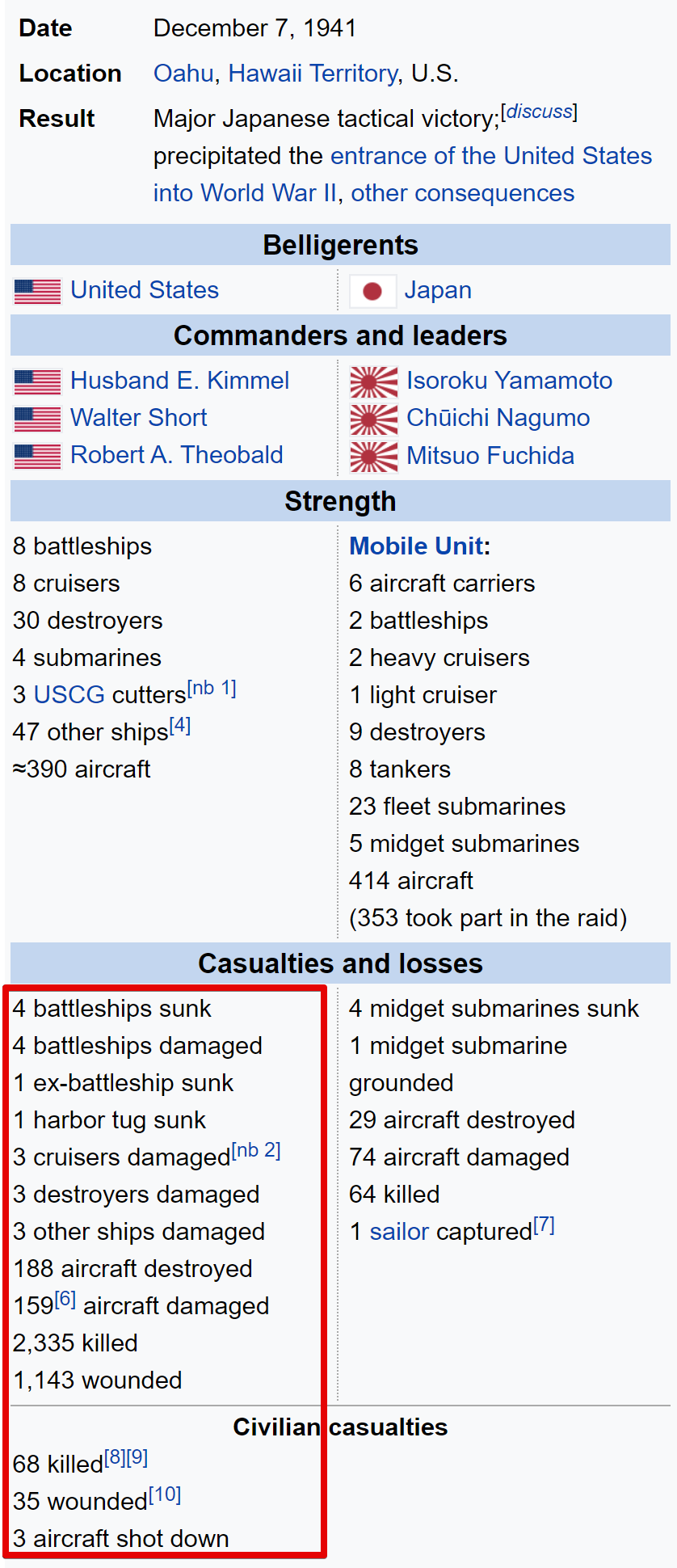
Napoleon vs. Россия
Our second essay? Napoleon’s tentative to invade Russia.
This is a famous (and superb) representation of what happened to the Grande Armée:
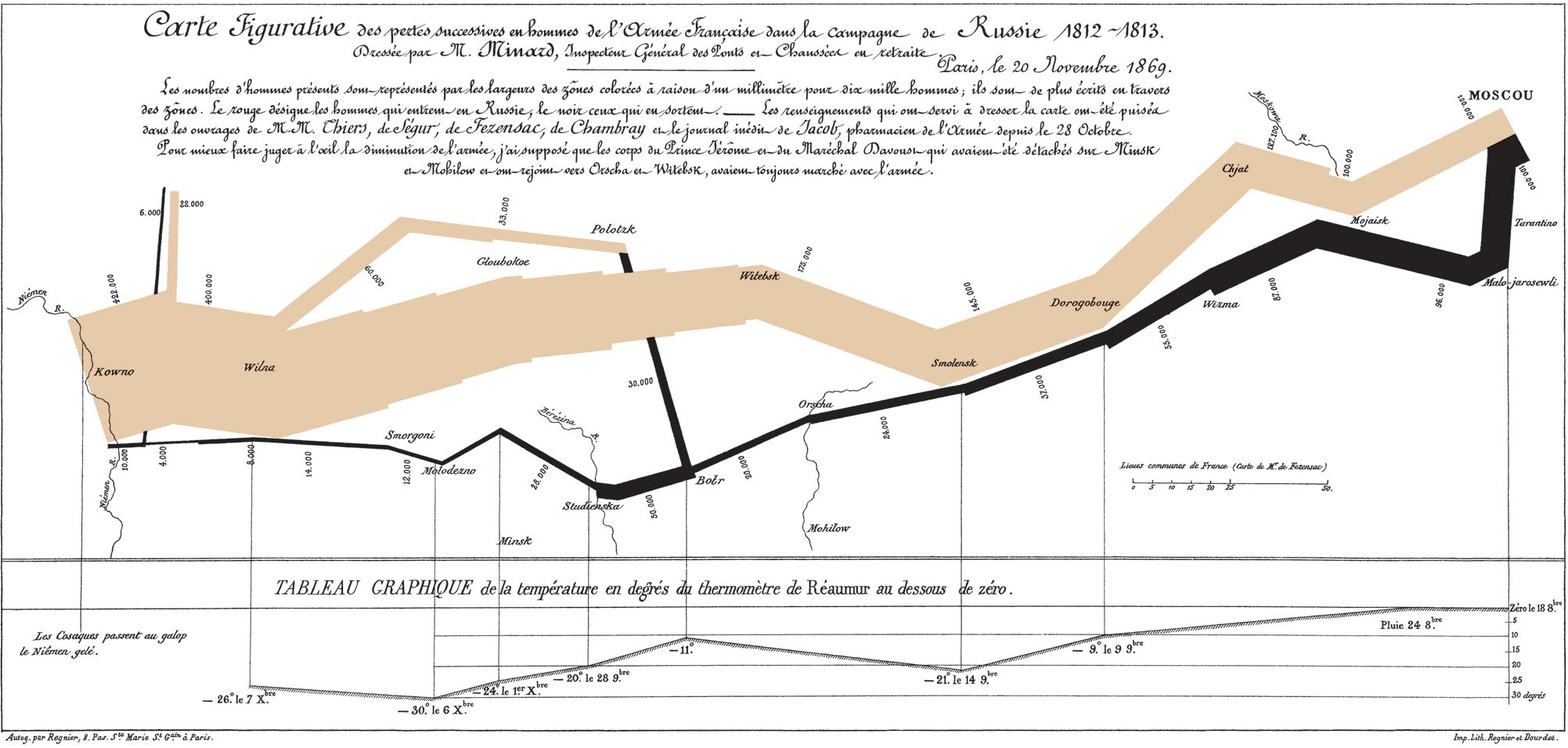
(notice the temperatures at the bottom)
For English-speaking enemies of Napoleon, here is a translated - and more readable - version:
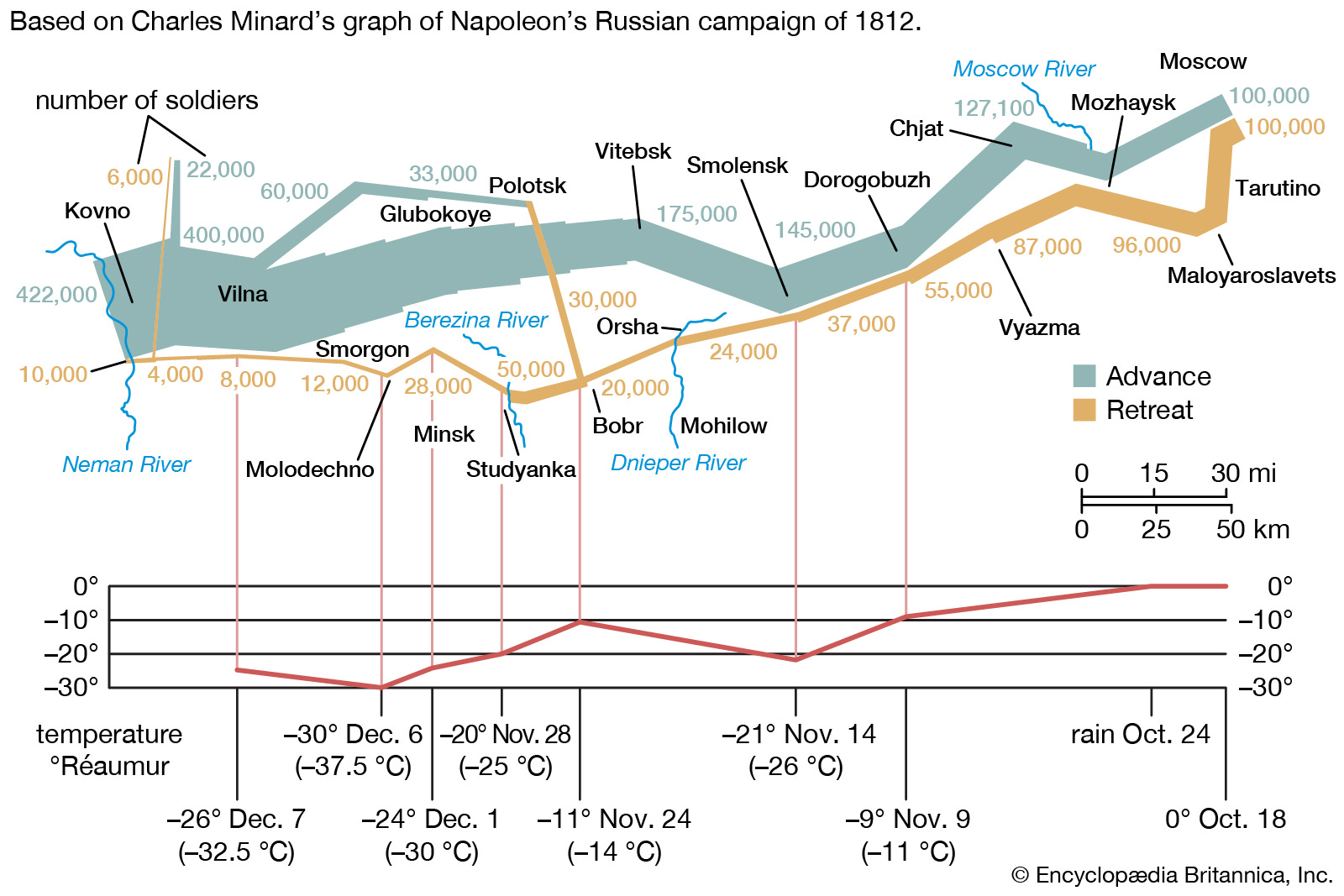
98% losses. When we talk about a disaster, French people still call it “la Berezina”. 200 years later.
I’m only sharing the most relevant extract because the whole essays is nearly an hour-read.
Everything You Need to Know About Napoleon Bonaparte 50min
Roberts describes a scene in 1812 when Emperor Napoleon is at the height of his power and success, and he’s sitting at a giant table in a palace in Paris with all of his political, diplomatic, and military advisors trying to figure out what to do with this Duchy of Warsaw situation. Russia had annoyingly dragged its feet on previous diplomatic commitments, having failed to effectively join Napoleon’s boycott of Britain, and now it was making demands that mighty France relinquish its influence over tiny Warsaw. Emperor Napoleon’s inclination was to amass France’s unstoppable army, steamroll across Russia’s richest regions, win a quick battle or two, and establish a more favorable long-term treaty with the second biggest European power.
Nearly all of Napoleon’s advisors said this was a horrible idea. His political advisors pointed out that France had been at war for nearly seven years straight and the people wanted to stop paying the high taxes and seeing their sons die across the continent. His diplomatic advisors said that the Duchy of Warsaw was a poor little plot of land on the other side of the continent and it wasn’t worth making a fuss over. His military advisors said that invading Russia was impossible, that they could never feed their army over there, and that the 400,000 Russian troops were nothing to scoff at. Napoleon had a few supporters here and there, but the mood in the room was clear… we can’t do this.
In hindsight, it’s easy to see how dumb of a decision Napoleon made. But as Roberts points out, Napoleon’s sentiment after hearing all of his advisors’ concerns was, I’ve heard this many times before, and I’ve always been proven right.
And it was true. On the eve of many wars and battles, Napoleon’s very talented advisors warned against his plans, and then Napoleon’s judgement and skill proved superior in the end. This happened over-and-over again until Napoleon went from being a random artillery colonel to basically the Emperor of Europe. Thus it might have been entirely rational for Napoleon to discount the judgements of others in 1812 when he proposed invading Russia. This wasn’t like Hitler moronically trying to micromanage Operation Barbosa because he made a few lucky calls during the early days of WW2, this was a true master of military strategy looking at the facts and making an informed decision. And it always worked! Until it didn’t.
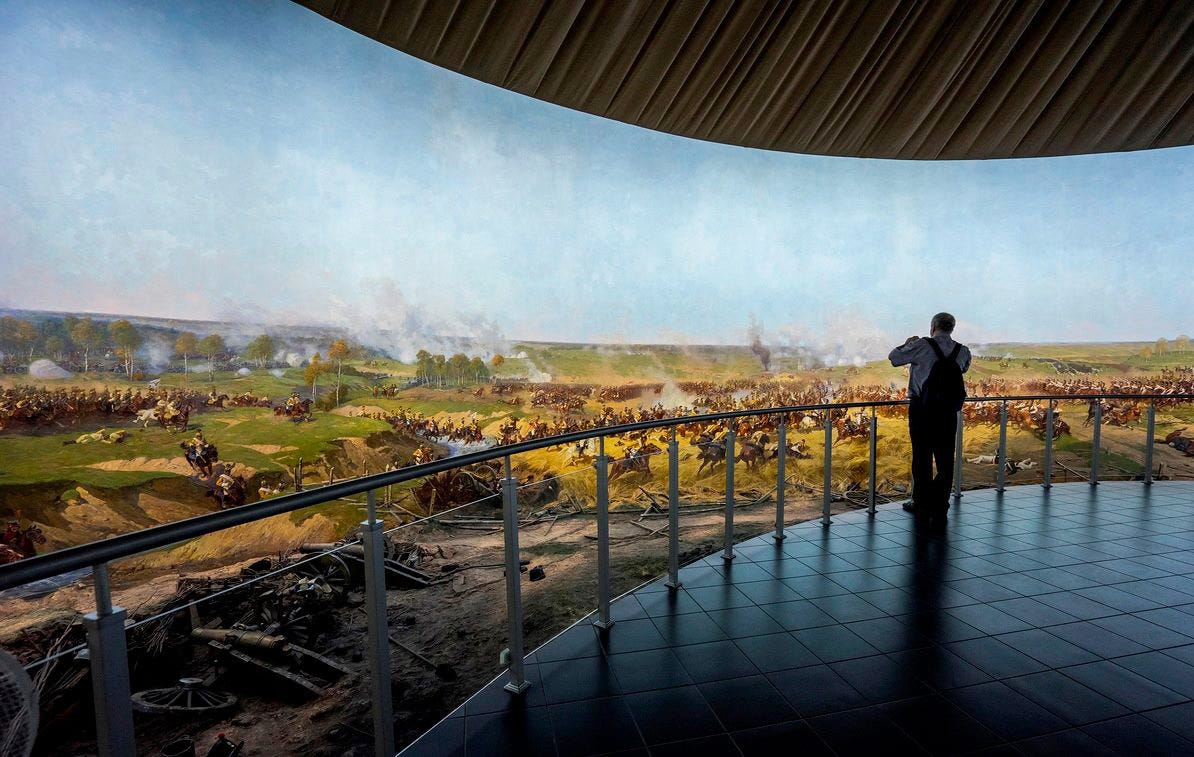
Russia has a wonderfully immersive museum to celebrate their crushing victory on Napoleon. Because he could not accept his limits.
(a bit weird to visit for a Frenchman)
The lessons learnt?
Cherish painful feedback.
Don’t try and find excuses. No one cares about excuses. People only care about outcomes.
Don’t get cocky.
Overconfidence kills. Napoleon, Hitler, Crassus… but also aggressive founders or investors on a winning streak.
Fail early.
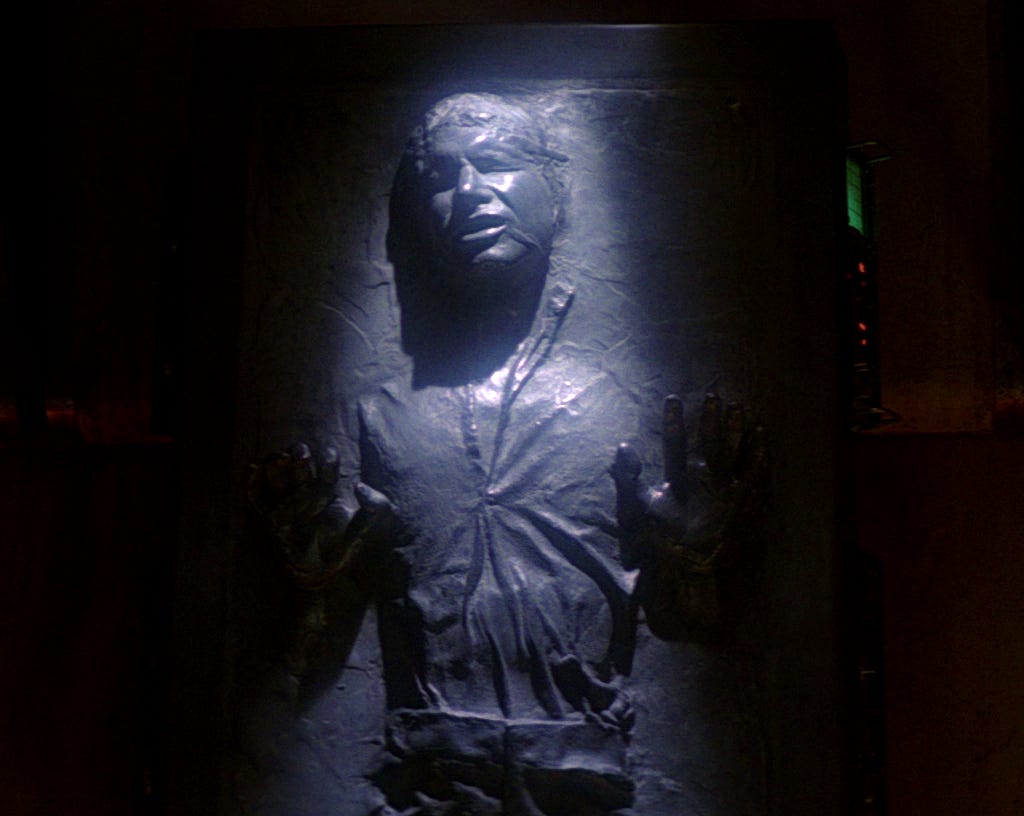
It’s less painful when the stakes are small. And you learn faster when your mental models are not yet frozen in carbonite.
Hope you enjoyed this anniversary issue. If you did, do not hesitate to share with like-minded people who love to learn about macro-trends, geopolitics, tech and investing.
Thanks for reading, and have a lessons-rich weekend,
V